
.png?width=1920&height=1080&name=5%20Years%20of%20National%20Grant%20Program%20Infographic%20(1).png)
2021 Recipients
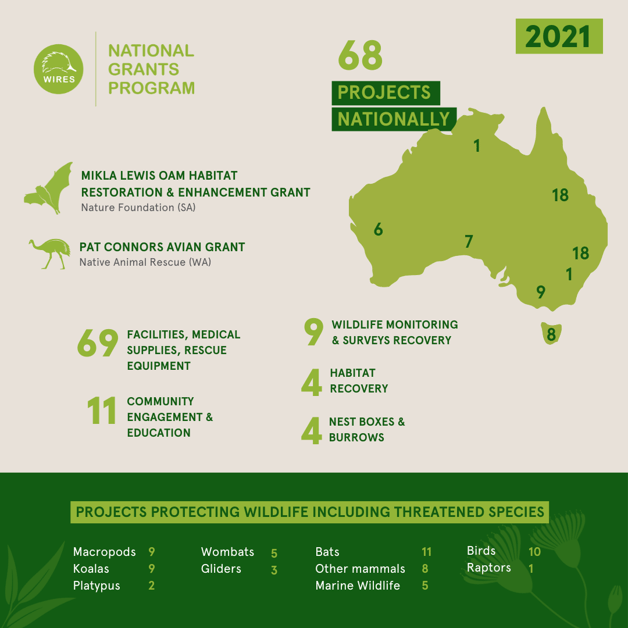
In 2021, there were 68 successful projects, with every state and territory across Australia represented.
ACT
- Tier 2 - ACT Wildlife Inc - Rescue equipment and consolidation
NSW
- Tier 1 - Numeralla Wildlife Shelter - Joey Shelter
- Tier 2 - Koala Conservation Australia Ltd. - Port Macquarie Koala Hospital Enclosure Enhancement and Plant Nursery
- Tier 2 - Wildcare Queanbeyan Inc. - Wombat Rehabilitation Recruitment (Spreading the love of wombat care)
- Tier 2 - Wildlife ARC Society Inc. - Increasing emergency preparedness and community awareness
- Tier 2 - Wildlife In Need of Care (WINC) - Season Preparation
- Tier 2 - LAOKO Snowy Mountains Wildlife Rescue - Australian Bat Lyssavirus (ABLV) Vaccination for LAOKO Rescuers
- Tier 2 - Hunter Wildlife Rescue - Emergency Management
- Tier 3 - Northern Slopes Landcare Association in partnership with North West Regional Koala Arks - Warialda Koala Education & Native Habitat Restoration program
- Tier 3 - Fix It Sisters Shed - Habitat production (burrows)
- Tier 3 - Friends of the Koala - Community Engagement Initiative
- Tier 3 - Clarence Landcare - Snap and Trap for Wildlife Protection and Community Engagement
- Tier 4 - Film Projects - The Koala Corridor
- Tier 4 - Wilsons Creek Huonbrook Landcare Inc - Top of the Range Glossy Black Cockatoo Nest Hollow Project Phase 2: Monitoring and Management
- Tier 4 - WildBnB Wildlife Habitat - Saving the Acrobats of the Forest
- Tier 4 - Murdoch University/Taronga Zoo - Investigating the Health and Disease of Platypuses in NSW
- Tier 4 - Charles Sturt University - Pre-Release Health & Post-Release Fate of Rehabilitated Wildlife
- Tier 4 - Griffith University - Leave It School - an online dog training program to reduce wildlife attacks
- Tier 4 - Western Sydney University - The Hawkesbury-Nepean Platypus Project
NT
- Tier 3 - Karrkad Kanjdji Trust - Wardekkan Mayh (Species) Recovery Project
QLD
- Tier 1 - Bundy Wildlife Rescue Inc. - Wildlife Intensive Care Units
- Tier 1 - TigerLodge WildCare
- Tier 1 - Wallabies RNR, wildlife rescue and release
- Tier 1 - Lana Field
- Tier 2 - The Agile Project - Wildlife Rescue - Medications, feeding equipment, formula + microscope for fecal float testing
- Tier 2 - Wildcare Wildlife Inc - Mobile Release Aviaries
- Tier 2 - Bat Conservation and Rescue QLD - Increasing Emergency Response Capacity for Large-Scale Flying Fox Events
- Tier 2 - Bat Rescue Inc. - Equipment
- Tier 2 - Queensland Koala Society Inc. - QLD Koala Society Rescue Equipment
- Tier 3 - Rainforest Rescue - ‘Repairing The World Heritage Daintree Rainforest’s Wildlife Habitats’ Project
- Tier 3 - Bats and Trees Society of Cairns Inc. - Save our spectacled flying-fox. Community education program and Enhancing care capacity to assist recovery of the species
- Tier 3 - Bush Heritage Australia - Saving Australia's smallest freshwater fish: Developing a more strategic approach to excluding invasive Gambusia fish from Red-finned Blue eye habitat.
- Tier 3 - Australian Animals Care and Education Inc. - Turtle Rehabilitation
- Tier 4 - Gympie and District Landcare Inc - Imbil Rail Trail Revegetation
- Tier 4 - Watergum Community - Fire-Effected Glider Habitat and Rescue Enhancement Project
- Tier 4 - University of QLD - Habitat restoration methods to conserve hollow-dependent threatened mammals and birds
SA
- Tier 1 - Adelaide Hills Kangaroo Rescue - Thermal Imagery
- Tier 1 - Flying Fox Heat Stress Kit
- Tier 2 - Kangaroo Pouch Animal Orphanage - Kangaroo Enclosure Extension
- Tier 2 - Adelaide and Hills Koala Rescue 1300KOALAZ - Koala Rescue & Rehabilitation Program
- Tier 3 - (Mikla Lewis Grant) - Nature Foundation - Helping secure the endangered Mount Lofty Ranges Southern Emu-wren
- Tier 3 - Foundation for Australia's Most Endangered Species Ltd - Reintroducing the Western Quoll & Red-tailed Phascogale back into the wild
- Tier 4 - Kangaroo Island Land for Wildlife Inc - KI Land for Wildlife Conservation Education Program
TAS
- Tier 1 - Cradle Mountain Wildlife Rehabilitation
- Tier 1 - Magra Haven
- Tier 1 - Native Corners Project
- Tier 1 - Wallaby enclosure 600m2
- Tier 1 - Hughenden Wildcare - M*A*S*H Ancillary Enclosure and treatment facility
- Tier 2 - Inala Foundation Inc. Bruny Island Wildlife Care
- Tier 2 - Tasmanian Wildlife Rehabilitation Council Inc. - Getting Existing Bat Flight Recovery Aviary Operational
- Tier 2 - Yolly's Wildlife Rescue - Demountable soft release enclosures
- Tier 4 - Devils@Cradle - Cradle Mountain off-Display rescue & rehabilitation facility - supporting species recovery programs for threatened carnivorous marsupials
VIC
- Tier 1 - Koalas of Raymond Island Inc.
- Tier 1 - Venomous snake rescue/rehabilitation
- Tier 1 - Reptile Rehab
- Tier 1 - Rescue Equipment
- Tier 2 - St Andrews Wildlife Shelter - Feeding Ringtails in care at St Andrews Wildlife Shelter
- Tier 3 - Red Box Wildlife Shelter - Project Preparedness medical facilities
- Tier 3 - Connecting Country Inc - Who's in that nest box? Empowering volunteers to monitor threatened phascogales
- Tier 3 - Murrindindi Ranges Wildlife Shelter - Adult Wombat Rehabilitation Facility
- Tier 4 - Phillip Island Nature Parks - Safe-Guarding Short-tailed Shearwaters
WA
- Tier 1 - Healing Hands Wildlife Care Inc. - Water tank for joeys in care
- Tier 2 - Western Australian Seabird Rescue - Increasing Seabird Rehabilitation Capacity in WA
- Tier 2 - Amaris Wildlife Sanctuary - Building a Wildlife Sanctuary
- Tier 2 - Bluebush Wildlife Rescue and Rehabilitation Inc. - Kangaroo Shelter
- Tier 2 - Goldfields Native Animal Care - Hopbush Pre-release Pen
- Tier 3 - (Pat Connors Grant) - Native Animal Rescue - Refuge Enclosures for Baby Black Cockatoos
WIRES is proud to be able to support these fantastic groups and projects, and we look forward to sharing the project updates and outcomes as they take place.
2022 Recipients
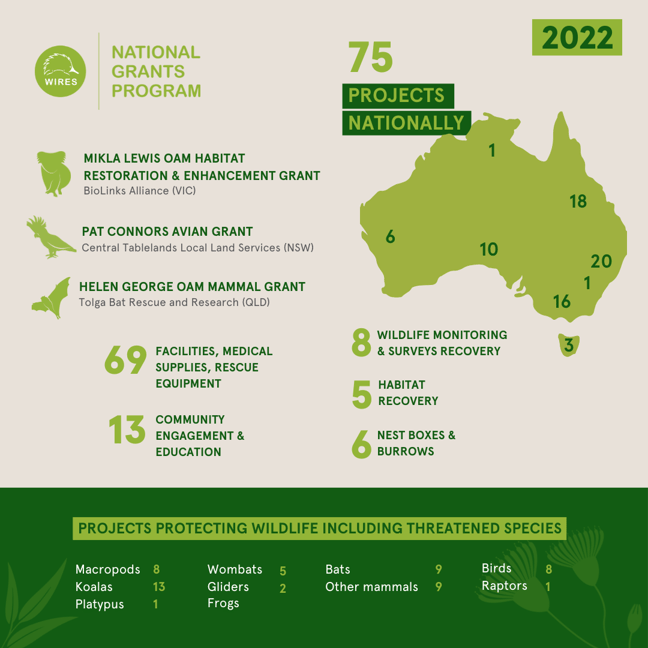
In 2022, there were 75 successful projects, with every state and territory across Australia represented.
The three special grants recipients were:
The Mikla Lewis OAM Habitat Restoration and Enhancement Grant – BioLinks Alliance (VIC)
Project - Heathcote Local to Landscape
The Heathcote Local to Landscape project will implement conservation measures in an agricultural landscape to provide sustainable, long-term habitat for native fauna. This will include monitoring health of older trees, weed management, revegetation of indigenous flora, provision of nest boxes and ongoing ecological management. A variety of threatened species are present in the area including Swift parrots, Brush-tailed phascogales and Powerful owls.
Pat Connors Avian Grant – Central Tablelands Local Land Services (NSW)
Project - Bringing Back the Glossy Black
The South-eastern Glossy-Black Cockatoo has suffered a significant population decline of 30-50% in recent decades, with the 2019-20 mega fires having resulted in extensive reductions to available feeding and breeding resources. It is estimated that only 7,500 exist in the wild. This innovative project will be the first in the world to use the newly developed Habitech Glossy-Black Cockatoo nest boxes developed specifically for this species. The project will also include two field days and the production and distribution of educational and promotional materials.
Helen George Mammal Grant – Tolga Bat Rescue and Research (QLD)
Project – Wildlife Friendly Fencing in the Wet Tropics
The grant is being used to purchase a pallet of barbless wire and encourage installation around the region. The project will run across the northern QLD wet tropics region, covering about 500kms from the Daintree to Townsville. Barbed wire can be deadly to range of wildlife and it is estimated tens of thousands of animals are entangled each year. The barbless wire will be provided to landowners alongside 'wildlife-friendly fenced property’ signage.
Grants Overview
Tier 1: Individual Licensed carers -24
Tier 2: Wildlife shelters and care groups - 25
Tier 3: NGO, Charities - 16
Tier 4: Consortia/multi party collaborations - 10
Total grants: 75
Geographic Breakdowns
New South Wales: 20
Queensland: 18
Victoria: 16
South Australia: 10
Western Australia: 6
Tasmania: 3
Australian Capital Territory: 1
Northern Territory: 1
Total Grants: 75
Project Categories
Habitat Recovery: 5
Nest Boxes and Burrows: 6
Habitat or Wildlife Monitoring and Surveys: 8
Equipment: 42
Building or Upgrading Facilities: 22
Medical Items: 5
Community Engagement and Education: 13
*some projects fall under multiple categories
WIRES is proud to be able to support these fantastic groups and projects, and we look forward to sharing the project updates and outcomes as they take place.
2023 Recipients
In 2023, there were 75 successful projects, across Australia.
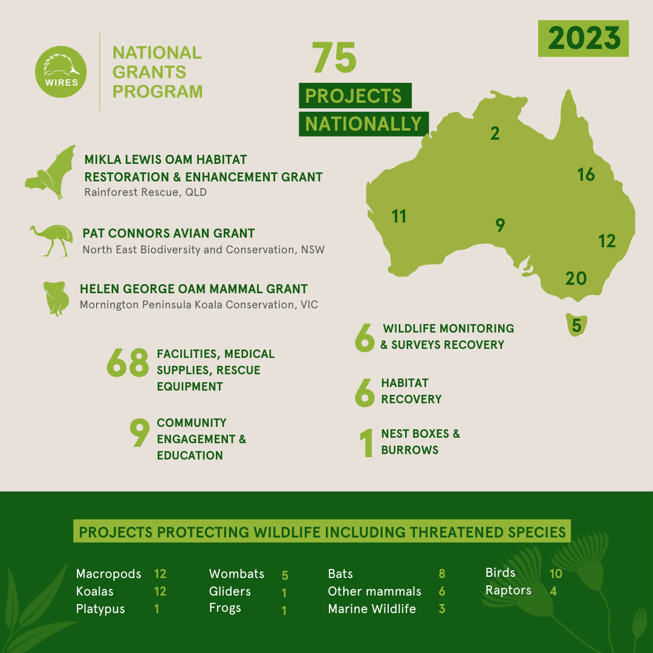
The three special grants recipients were:
The Mikla Lewis OAM Habitat Restoration and Enhancement Grant – Rainforest Rescue (QLD)
Project - Restoring & Rebuilding Bat Rainforest Habitat and Population
In 2015 Rainforest Rescue was approached by land-owner Annie Shoenberger, owner and founder of NightWings Rainforest Centre and devoted bat carer, to transform fifteen hectares of old sugarcane fields into thriving Daintree lowland rainforest. Since then, tens of thousands of trees have been planted at NightWings by staff and volunteers, to repair this damaged land and re-build a vital wildlife corridor between the upland rainforest and beyond to the coast.
Use of the grant:
- Wetland earth works at NightWings, involving the planning, preparation, labour costs, materials, approvals from council and hiring of a contractor to perform the excavation work
- Ongoing audio and visual monitoring and species' metric collection of bat life at NightWings, performed by our collaborating partner Flying-foxes FNQ
- Local education initiatives that focus on creating awareness and education around activities to keep flying foxes safe especially through heat waves, communicated through schools and local market stalls and events. It's important also to change attitudes towards flying foxes as there is some negative perception. We'd also like to - through our New Nursery too - recommend specific species for local residents, organisations, who are interested in protecting flying foxes in their own backyard and increasing their populations by providing safe habitat (i.e planting melaleucas etc).
- The planting of 500 wetland species of rainforest seedlings in the wetland area.
Pat Connors Avian Grant – North East Biodiversity and Conservation (NSW)
Project - Endangered Coastal Emu Population Supplementation
This project is a component of the broader Coastal Emu endangered population conservation project within the NSW Saving our Species program. The Coastal Emu endangered population, genetically different from inland emu, is estimated to be fewer than 50 individual birds. To assist recovery of the population, Saving our Species is undertaking a captive incubation, chick raising and release program. Chicks hatched from wild eggs collected will be raised to 3 - 6 months of age before being released to an internal area dubbed an 'airlock' within a larger feral predator free area (soft-release site) on private property. This project will assist the birds' transition from the 'airlock' to the larger feral predator free area. In addition, this project will form a blueprint for recovery of emu following bushfire or other natural disaster and increase capacity for emergency responses.
Use of the grant:
- Provision of husbandry activities including supplementary feed (if required) and minor field consumables
- Purchase and operation of five wildlife monitoring cameras for strategic placement inside the feral predator free 'air lock' area
- Infill plantings as food sources for the emu chicks, to be undertaken by a local team of Indigenous bush regenerators
- Awareness raising activities for the Coastal Emu, including contribution towards an Emu Festival to be hosted by our Indigenous partners
- Collection of eggs from wild nests (under our current Scientific License and Animal Research Authority (attached), for incubation and hatching in August 2024.
Helen George Mammal Grant – Mornington Peninsula Koala Conservation (VIC)
Project – Western Port Bay Biolink Project
Mornington Peninsula Koala Conservation MPKoalas Conservation is restoring fragmented koala habitat, where 70%+ of koala habitat is private land. Our very successful project has been running since 2019 and requires funding for 2024 and beyond, to increase tree canopy and revegetate farmland. We aim to plant more than 25,000 indigenous plants annually.
The project is based on the Mornington Peninsula and aims to strengthen vegetation surrounding Western Port Bay, a UNESCO biosphere reserve and Ramsar site. Over several years, the project will focus on the area between HMAS Cerberus (Somers) and Pearcedale to increase tree canopy and vegetation and assist with creating a green belt around the bay to aid wildlife movement.
The scope of the project each year usually involves around 25-30 mostly private properties in our target area. In 2024 the target area will be from HMAS Cerberus in Somers to the town of Tyabb.
Grants Overview
Tier 1: Individual Licensed carers -22
Tier 2: Wildlife shelters and care groups - 33
Tier 3: NGO, Charities - 15
Tier 4: Consortia/multi-party collaborations - 5
Total grants: 75
Geographic Breakdowns
New South Wales: 12
Queensland: 16
Victoria: 20
South Australia: 9
Western Australia: 11
Tasmania: 5
Australian Capital Territory: 0
Northern Territory: 2
Total Grants: 75
Project Categories
Habitat Recovery: 6
Nest Boxes and Burrows: 1
Wildlife Monitoring and Surveys: 6
Facilities, Medical Supplies, Rescue Equipment: 68
Community Engagement and Education: 9
*some projects fall under multiple categories
WIRES is proud to be able to support these fantastic groups and projects, and we look forward to sharing the project updates and outcomes as they take place.
2024 Recipients
In 2024 there were 68 grants awarded in 4 tiers across Australia.
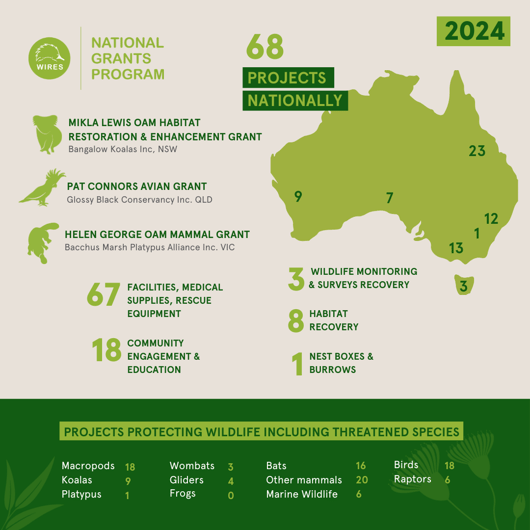
The three special grants recipients were:
The Mikla Lewis OAM Habitat Restoration and Enhancement Grant - Bangalow Koalas Inc. NSW
Project - Coraki Community Riparian Wildlife Corridor
Use of the grant: Bangalow Koalas is a not-for-profit organisation that delivers largescale habitat creation and restoration projects in the Northern Rivers NSW. Our vision is to create a wildlife corridor by planting 500,000 trees by 2025 linking habitats between Byron Bay, Tenterfield, the Queensland border and Grafton to provide a safe route for endangered koalas and other wildlife to move safely through our highly fragmented landscape. The project site is on the north bank of the Wilsons River in an extensively cleared landscape. Safe wildlife movement is restricted to existing narrow riparian areas which are currently dominated by invasive weeds (including dense infestations of vines) which has reduced the availability of wildlife food species and inhibits wildlife movement. Local bush regenerators will be contracted to restore 4.4ha of riparian habitat in Coraki through primary weed control, tree planting and maintenance. They will also advise the landholder on the best methods for ongoing maintenance.
They will undertake primary weed control on 2.43ha of riparian habitat along a 1,124m stretch of the Wilsons River removing lantana, climbing asparagus, balloon vine and white glycine by hand weeding, cut and scrape and foliar spray. Following this they will plant 2410 native trees and shrubs of known value to wildlife which are representative of the existing vegetation community on another 2.17ha directly adjacent. These will be planted at a 60/40 mix of koala trees and other species to create a structurally and species diverse habitat and provide a continuous high quality riparian corridor for wildlife along the Wilsons River. Contractors will maintain the areas 8 times.
The Pat Connors Avian Grant - The Glossy Black Conservancy
Project - Habitat mapping for the vulnerable Glossy Black-Cockatoo in Southeast Queensland
Use of the grant: The Glossy Black Conservancy is an independent conservation and research organisation providing resources, training and support to people and groups so that they can identify, collect data and take action to protect the nationally vulnerable Glossy Black-Cockatoo and its habitat. Southeast Queensland is the fastest growing region in Australia and holds critical stands of habitat for the nationally-listed Glossy Black-Cockatoo. Habitat mapping for this species, which has been severely impacted by 2019 bushfires, was last undertaken in 2016. Researchers, Councils and State Government are making planning and policy decisions about the species, using data that is woefully out-of-date. The grant will be used to update habitat mapping for the nationally-listed Glossy Black-Cockatoo in Southeast Queensland - one of Australia’s regions at greatest risk of habitat clearing.
We will engage an ecologist to gather data from known sources as well as a GIS specialist with skills in creating habitat mapping to drive conservation outcomes. Together, these specialists will work with the Conservancy’s Science & Research committee to update Taxon Profiles and ensure mapping is to a standard that will inform Essential Habitat as defined by the Queensland Vegetation Management Act (1999).
Once mapping is complete, we’ll two webinars focused on sharing mapping methodology and Taxon Profiles so the project can be replicated across the country. And a third that will focus on Councils of SEQ to share mapping methodology and drive incorporation of new mapping data into local planning instruments, to maximise habitat protection.
The Helen George OAM Mammal Grant - Bacchus Marsh Platypus Alliance Inc.
Project - It takes a town to save a platypus
Use of the grant: Bacchus Marsh is currently experiencing rapid urban growth, putting platypus and other local native wildlife at risk. This is a multi-facted project, focusing on involving all sectors of the local community in preserving platypus and their habitat in Bacchus Marsh. This includes new residents to Bacchus Marsh, many of whom are from culturally and linguistically diverse backgrounds, as well as the local building industry. The project delivers a community engagement campaign, including a short animated video, brochures and booklets; community workshops; followed by direct community action in helping keep local platypuses safe. Each part of the project is designed to build upon the other.
Grants Overview
Tier 1: Individual Licensed carers -23
Tier 2: Wildlife shelters and care groups - 25
Tier 3: NGO, Charities - 11
Tier 4: Consortia/multi-party collaborations - 9
Total grants: 68
Geographic Breakdowns
New South Wales: 12
Queensland: 23
Victoria: 13
South Australia: 7
Western Australia: 9
Tasmania: 3
Australian Capital Territory: 1
Total Grants: 68
Project Categories
Habitat Recovery: 8
Nest Boxes and Burrows: 1
Wildlife Monitoring and Surveys: 3
Facilities, Medical Supplies, Rescue Equipment: 67
Community Engagement and Education: 18
*some projects fall under multiple categories
WIRES is proud to be able to support these fantastic groups and projects, and we look forward to sharing the project updates and outcomes as they take place.
2025 Recipients
In 2025 there were 76 grants awarded in 4 tiers across Australia.
.png?width=504&height=504&name=NGP%20Infographic%20(2).png)
The three special grants recipients were:
Mikla Lewis OAM Habitat Restoration and Enhancement Grant - The Gondwana Rainforest Trust
Project - Avian Megafauna Corridor Restoration Project
Use of the grant: Gondwana Rainforest Trust has been awarded $20,000 to help deliver the Avian Megafauna Corridor Restoration Project in Far North Queensland, reconnecting lowland tropical rainforest with the World Heritage–listed Daintree National Park. Over 12 months, the project will restore previously cleared land through the planting of 6,000 rainforest trees, strengthening vital wildlife corridors for threatened species, including the endangered Southern Cassowary. The project will also include independent summer and winter fauna surveys to guide long-term conservation efforts and support best practice habitat restoration, ongoing land care, and the well-being of wildlife on Trust-owned land.
Pat Connors Avian Grant - The University of Queensland
Project - Addressing a critical wildlife emerging issue: A multidisciplinary approach to determine the cause of Lorikeet Paralysis Syndrome
Use of the grant: The University of Queensland is leading a groundbreaking investigation into Lorikeet Paralysis Syndrome (LPS), a seasonal and often fatal neurological condition affecting Rainbow Lorikeets across south-east Queensland and north-east New South Wales. With the cause of LPS remaining unknown for more than 15 years, the project will use advanced toxicological testing to examine two suspected naturally occurring toxins — botulinum neurotoxin (BoNT) and ricinine, derived from the invasive castor oil plant. By testing affected birds, environmental samples from known hotspots, and developing non-invasive diagnostic methods, the research aims to strengthen wildlife disease surveillance, reduce pressure on wildlife hospitals, and inform wildlife conservation policy to protect Australia’s native bird populations. They have received a grant of $47,398.
Helen George OAM Mammal Grant - The Conservation Council of WA
Project - Climate Change Adaptation and Habitat Replacement for WA Bat Fauna
Use of the grant: The Conservation Council of WA is utilising this grant of $17,160 support bat conservation in southwest Western Australia through research, habitat restoration and community engagement. The project will identify and monitor bat roosts, trial artificial roosting structures to replace declining tree hollows, and collect critical data to inform conservation policy and climate adaptation strategies.
Grants Overview
Tier 1: Individual Licensed carers - 24
Tier 2: Wildlife shelters and care groups - 25
Tier 3: NGO, Charities - 18
Tier 4: Consortia/multi-party collaborations - 9
Total grants: 76
Geographic Breakdowns
New South Wales: 6
Queensland: 28
Victoria: 20
South Australia: 10
Western Australia: 8
Tasmania: 2
Australian Capital Territory: 2
Total Grants: 76
Project Categories
Habitat Recovery: 11
Nest Boxes and Burrows: 6
Wildlife Monitoring and Surveys: 19
Facilities: 29
Medical Supplies: 23
Rescue Equipment: 30
Community Engagement and Education: 18
*some projects fall under multiple categories